

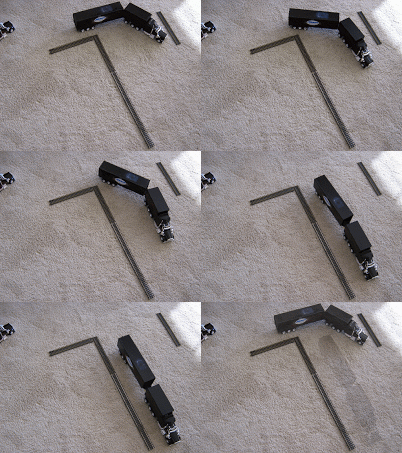
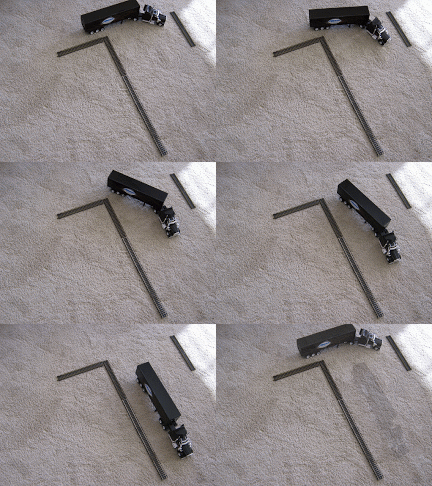
 105′ Radius ACCORD-Stinger 90′ Turn 63′ Semi 90′ Turn 53′ Semi
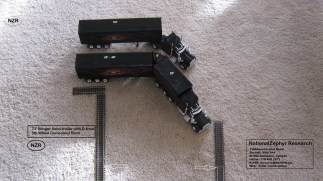
COMPARE: NZR ACCORD-Stinger 63′ with Standard 53′ Semi-trailer


NZR ACCORD-Stinger 53′ & 63′ (5,6) & (7) Axle US – Leland James, Founder of Freightliner Corp NZR – Improving Capacity ACCORD-Stinger 2018
Truck OEM’s benefit from concept: KW, Pete, Volvo, Ftlnr, W/Star, Mack, Navistar, etc
Trailer OEM’s benefit from concept: Gt. Dane, Stoughton, Wabash, Utility, CIMC, Monon Vanguard, etc
All tractors may adapt to ACCORD Technology using Patented d-TRAiN© 5th Wheel Compound Hitch tractor Package
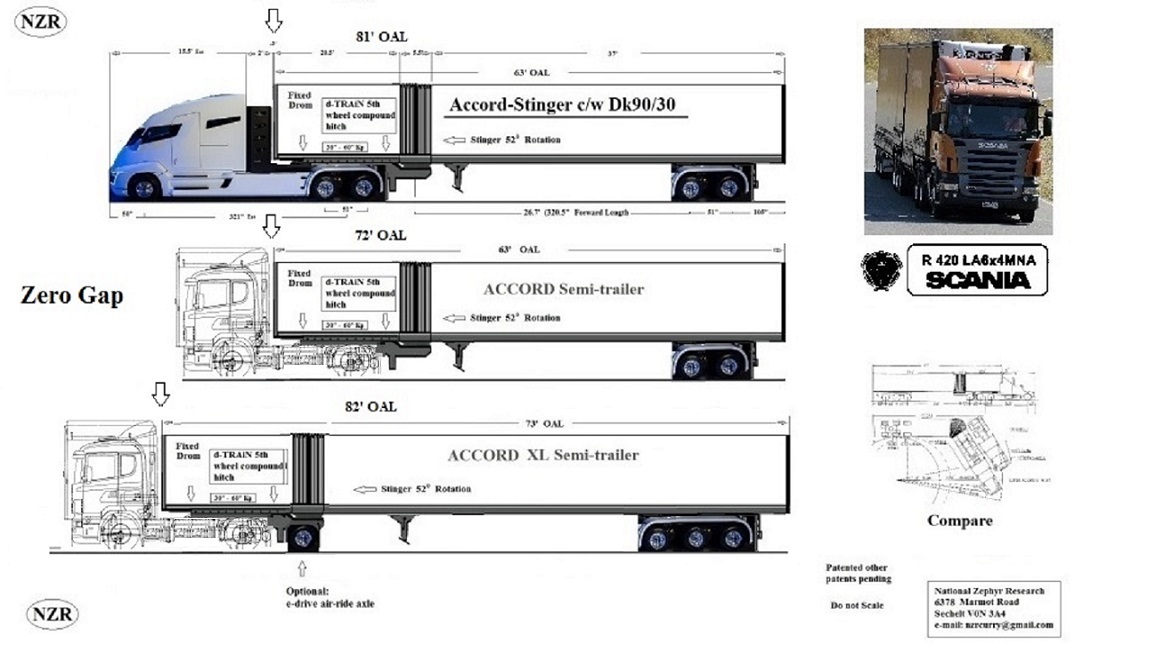

North American and EU Configurations
10.4.1 Tractor-Trailer Scale-Model Testing The NRC 9m x 9m Wind Tunnel provides the ability to test quarter to half scale tractor-trailer models at representative Reynolds numbers, with ground-effect simulation and, with some additional effort, representative turbulence conditions.
Recently, a correlation study between a half-scale tractor-trailer model and its full-scale equivalent was performed in the NRC 9m x 9m Wind Tunnel. After correcting for blockage and wall-interference effects, the results of the study showed good correlation between the two models and identified the importance of proper ground simulation for some changes in model configuration.
The results indicated the importance of ground-effect simulation for assessing the effects of drag reduction technologies located in ground proximity. The study was a collaboration between NRC-IAR and a truck manufacturer and has not yet been published. Dissemination of the results into the public literature will occur within the next year.
This study provides confidence that scale-model testing at representative Reynolds numbers will be efficient and provide adequate guidance for the design and evaluation of drag reduction technologies. The inclusion of representative turbulence and wind-profile conditions (see Section 11.3) would provide a reliable and systematic approach to the evaluation of tractor-trailer aerodynamic performance. Front-surface modifications will be the most susceptible to Reynolds-number effects and therefore full-scale Reynolds number conditions are the ideal situation for examining such modifications.
Testing of a half-scale model in the 9m x 9m Wind Tunnel can achieve full-scale Reynolds number conditions with the ground effect simulation system. For this scale, the wheels of the model straddle the edges of the 1 m wide ground-plane belt. Although this situation is better than a fixed ground plane, it is not ideal for examining under-body and rotating-wheel effects. Also, at half scale the trailer extends beyond the length of the NRC ground-plane belt, which is only 5.3 m long. At quarter scale, a full-length model (with equivalent 53 ft trailer) will sit within the confines of the ground-plane belt (belt equivalent to 21.2 m/70 ft scale) and will therefore allow fully-representative under-body simulation. Such a model could also allow the moving belt to drive the wheels and provide an improved simulation of the wheel-road interactions (further discussed in Section 11.3.1).
The Reynolds number for this situation would be half of the full-scale conditions, but underbody flows are likely to be less susceptible to Reynolds-number effects due to the turbulent-wake-like characteristics of much of this flow. As noted above, it is primarily front surfaces that require the full-scale Reynolds numbers associated with a half-scale model. Although the large range of second-generation drag-reduction devices affect the gap and trailer flows, it is possible that insufficient Reynolds number simulation of the fore-body may have an effect on the downstream flows.
The arguments above lead to the conclusion that there is no optimum model scale for testing tractor trailers in the 9 m x 9 m Wind Tunnel with ground effect simulation. Quarter-scale models are the most appropriate for testing drag-reduction devices on a full-length trailer model, while properly simulating the under-body flows and ground. Half-scale models will provide adequate Reynolds-number simulation, important for the tractor fore-body flows but will not provide full under-body ground effect simulation. Before an appropriate model scale is chosen for such studies, it will be important to understand the implications of this trade-off. Section 10.6 provides recommendations for such a trade-off study.
 National Zephyr Research